
Go-to-market looks a lot different in the era of AI. What was once a predictable playbook, has become a dynamic landscape.
Starting first with the broad strokes.
With the barrier to entry on creating new products at zero and increasingly available to those that are non-technical, for the first time, it has become harder than ever to get products noticed. There’s more competition, and the aggregate number of products released into the market will only increase from here, likely exponentially. This puts more pressure on distribution.
Along with this, search has started its slow march toward AI summaries and AI originated queries.
We have the unique purview of seeing these trends across our five companies and have seen a linear increase in the number of impressions in search, but a precipitous drop in the number of clickthroughs, both within Google and AI tools like GPT and Claude. This speaks to the reality that many are seeing from publishing to software – AI summaries may increase brand awareness (if targeted and optimized correctly, which we’ll get to later) – but decrease the number of people that follow to your website or product.
This means fewer direct leads and sign ups from search, which historically has been one of the most meaningful growth channels for technology companies. At the very least, it’s been one of the most cost effective ways to generate demand at scale. That channel is now more limited in its effectiveness.
Across the rest of the marketing stack, the other channels that have traditionally been strong candidates for driving demand are also more competitive. With organic search not performing as it once did, that naturally drives more attention to paid acquisition. That increased competition has raised CPMs and CPCs, putting strain on the typical CAC to LTV conversion that many are working backwards from. The math is becoming much harder to math.
Outbound sourcing is also now congested with AI-generated bots that drown inboxes, and email marketing as a channel is effective, but increasingly demanding user-level sophistication in how those emails are targeted. Social media is important given the scraping that is happening to feed AI datasets, but again, competitive as more content is created.
So where does that leave us? In short, the answer is nuanced.
This is the primary topic within Curious at the moment as we continue to develop distribution as a moat for our companies. Here’s where we’re focused.
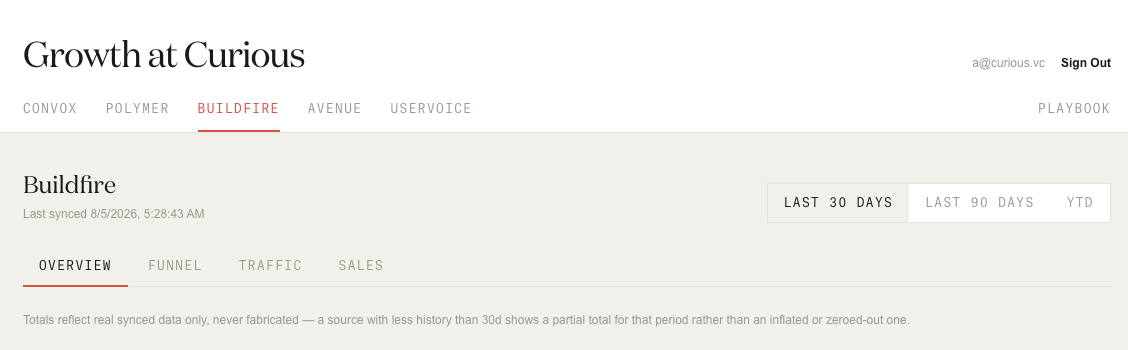
Many of the failures that exist in building a repeatable growth motion fail at the funnel level. It’s critical to understand the path of a prospective customer through each step of the funnel to discover where your current process is not converting as it should. Along with that, you need to understand which channels are driving those conversions, so you can better understand what channels need additional investment and which need to be pulled back. This is a philosophy I've been advocating for many years, and is still overlooked today.
Even in the AI era, where tools and data are plentiful, this step often gets skipped. That’s certainly been the case in the businesses we’ve acquired. So step one, which we’ve built internally for all of our companies, is to pull in all of the disparate data sources for each company (Hubspot, Posthog, Google Analytics, etc.) to get a clear view of the funnel, from top to bottom. With that, you have a true view of what's working and what isn't.
The importance of on-site content for software companies has never been more clear. Not only is organic search increasingly reliant on long-tail pages to feed demand, there’s also AEO (Answer Engine Optimization) that relies almost entirely on the content you and the rest of the web are feeding it about your company.
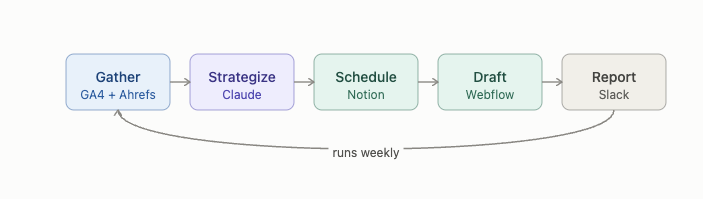
This puts more pressure on an automated process of keyword discovery and initial page or content creation, which can then be modified. Internally, we’re calling this our “Curious Content Engine” and it’s actively in flight across Buildfire and Uservoice. The goal here is to surface specific terms of question based intent (which AEO relies heavily on) and generate those specific pages or posts to fill the gap in presence. You can view an example on Buildfire here, and on Uservoice here - both were automatically targeted and created using our content engine.
This has had a dramatic impact on organic search ranking and visibility within AI tools for both companies, and we’re rolling this out to the rest of our companies now. We believe increasingly that creating content at scale is table stakes in creating inbound demand.
Finally, with inbound channels being more difficult to predict, growth is begging for a predictable channel that can drive demand.
That puts more pressure on building paid campaigns that are actually driving qualified leads and sign ups. Like I mentioned above, CPMs and CPCs have increased given this demand, particularly for broad or branded terms. This pushes the focus towards long-tail terms that show specific intent and are less competitive. Many of the pages that have been created through our content engine end up being great candidates for the landing pages on these long-tail paid campaigns. This results in more campaigns to manage and more detailed targeting, along with unique ad creative (ad copy and images) to support that specific query. This scale again begs for a more automated approach. This is the next major step for our internal building.
Notably, I've left off many other channels, like email marketing, social media marketing, referral marketing, etc. This isn't because they're not important or not effective, it's simply due to focus and placing our bets on the highest impact channels first. This is a fast-moving and evolving topic, so we'll continue to share what we're building as we ship it across Curious.
Curious is a long-term holding company that buys and grows software companies with empathy.
Join the Curious Dispatch to receive our latest thinking, news, and opportunities within our portfolio.
